
Large Australian eCommerce Retailer
AIO Case Study
Winning in AI Search
For a large Australian eCommerce retailer backed by national TV advertising, AI search optimisation lifted sales from AI assistants more than 7x a month, and the brand now appears in 4 of every 10 AI answers we track.
| Result | Before (Jan–Jun 2026) | After (Jul–Oct 2026) |
|---|---|---|
| Sales from AI assistants (avg per month) | 1.3 | 9.5 |
| Visits from AI assistants (avg per month) | Baseline | +175% |
| AI visibility across 5 engines | — | 40% |
The client
The client is a large Australian eCommerce retailer that invests heavily in TV advertising. Our brief had two parts: win new customers online, and protect the TV spend, so viewers who search for the brand or a product they’ve just seen on screen find the client first, in AI search and in the search engines.
The challenge
That moment after the ad has changed. Viewers now ask ChatGPT, Gemini and Google’s AI Overviews questions like “Is [brand] a good company?” or “Where can I buy [product from the ad]?”. In a crowded online market, if the answer points to a marketplace, a review site or a big-box competitor, the TV spend generates someone else’s sale.
The goal: make the client the brand that AI assistants and search engines name, and its website the source they link to.
Our approach
We applied Search Rescue’s three-part AI optimisation framework, measured weekly across 40 buyer prompts and five AI engines (ChatGPT, Google Gemini, Google AI Mode, Google AI Overviews and Perplexity).
Content
We created a large volume of fresh content across the client’s product range, giving AI engines and search engines the context they need to recommend each product.
- Expanded “more info” product content and FAQs on key TV products, written around the 40 buyer prompts we track in AI search.
- A detailed brand and audience brief, so every page and article speaks in the client’s voice and leads with its selling points.
- A new blog section with monthly articles targeting priority keywords and linking back to product pages.
Technical
We made the site easy for AI engines and search engines to read, trust and cite.
- An llms.txt file to guide AI crawlers to the client’s most important content.
- Structured data (schema) markup, plus page titles, meta descriptions and image alt tags added wherever they were missing.
- A go-live SEO audit, followed by monthly fixes from site-audit and Google Search Console errors.
- Meta title and description guidelines for the client’s product team, so every new product launches search-ready.
- Technical SEO and AI-search recommendations delivered ahead of the client’s platform migration.
- Expanded “more info” product content and FAQs on key TV products, written around the 40 buyer prompts we track in AI search.
- A detailed brand and audience brief, so every page and article speaks in the client’s voice and leads with its selling points.
- A new blog section with monthly articles targeting priority keywords and linking back to product pages.
Reputation
We strengthened the trust signals AI engines and shoppers rely on.
- Built out the client’s Google Business Profiles in Australia and New Zealand, with a review QR code to grow Google Maps reviews.
- Worked with the client on product reviews, adding a review summary to each key product page.
- Reviewed and made recommendations on the client’s Google Merchant Center brand profile.
- Ongoing monthly backlinking from relevant, authoritative sites.
Every week we tracked visibility, average position, mentions, citations and sentiment, then fed the gaps back into the next round of content.
Results: AI visibility, mentions and citations
The brand now appears in 40% of tracked AI answers, at an average position of 3.1, across 8,926 sentiment-bearing mentions analysed.
Visibility by AI engine (Jan–Oct 2026)
| AI engine | Visibility | Avg. position |
|---|---|---|
| Google Gemini | 47% | 2.5 |
| Google AI Mode | 40% | 3.5 |
| Google AI Overviews | 40% | 3.3 |
| ChatGPT | 28% | 3.0 |
| Perplexity | 26% | 2.8 |
The client’s own website is now the #1 cited source in its AI answers, ahead of the review sites and big-box retailers competing for the same answers.
| Cited source | Share of AI answers | AI answers citing it |
|---|---|---|
| Client website | 35.0% | 3,124 |
| National product review site | 31.2% | 2,784 |
| National discount department store | 19.5% | 1,743 |
| Video platform | 19.2% | 1,710 |
| National electronics and homewares retailer | 18.4% | 1,645 |
Top prompts.
The brand is named in 100% of AI answers to reputation questions such as "Is [brand] a good company in Australia?" (position 1) and 98% for "[brand] reviews Australia". On the "where can I buy" questions TV viewers ask about advertised products, it now appears in 77–80% of answers, sending buyers straight to the client's site.
Results: clicks and sales from AI assistants
Optimisation went live on 24 June 2026. In the four full months since (July to October), AI assistants sent the client 38 orders, versus 8 orders in the six months before.
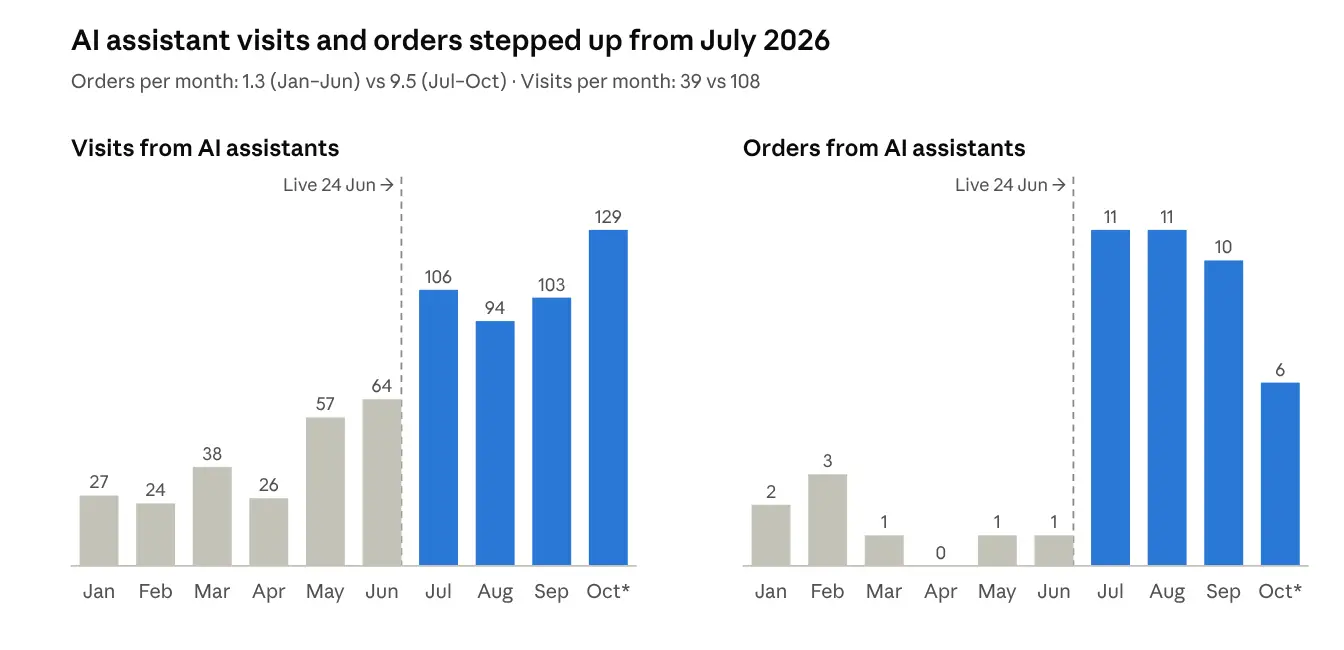
Google Analytics 4 · sessions from chatgpt.com, gemini, perplexity and copilot · Jan 2026 – 25 Oct 2026 (*Oct partial)
Weekly AI Assistant sessions in Google Analytics 4, June–October 2026
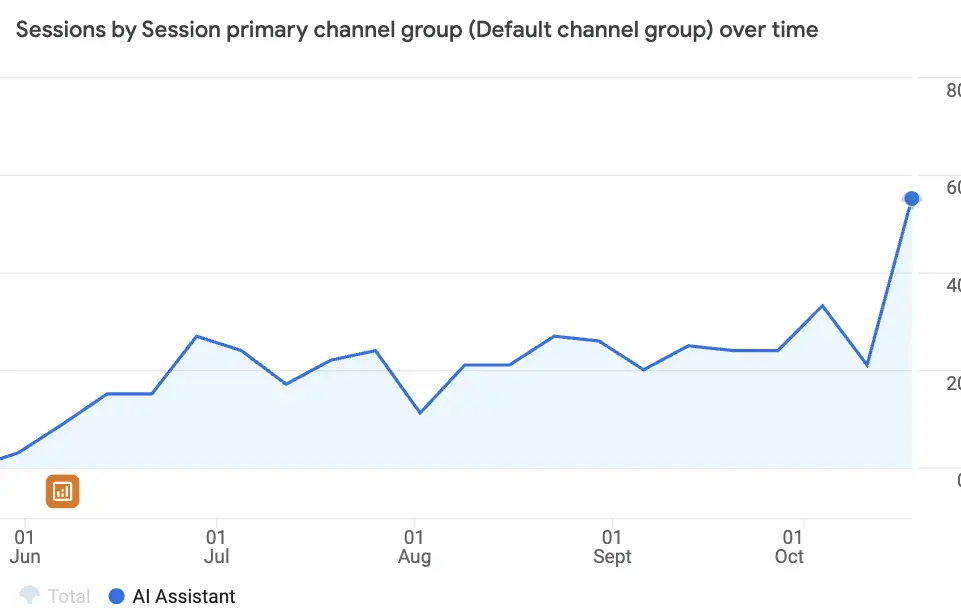
ChatGPT drives most of it: 398 of the 432 AI-referred visits since July came from chatgpt.com.