Ecommerce Digital Marketing Sydney
Here at Search Rescue we simply love ecommerce digital marketing campaigns! The ability to track and optimise based on revenue and profit is simply the most efficient and powerful method as compared to optimising for phone calls or form submissions. These are not true indications of leads and profit whereas a sale is a sale!
Free eCommerce audit
See what exactly we’d fix. No obligation.
Response within 1 business day.
TRUSTED BY LEADING BRANDS











last year
for clients
managed
Google reviews
Google Ads Agency
The primary metric you should be looking at in your own marketing, or asking of your agency for is return on ad spend (ROAS). ROAS is how many dollars of revenue you get from 1 dollar invested. Google offers strategies like maximum conversion value at a target ROAS or just maximise conversion value. Based on the revenue and ROAS signals of your Google shopping campaign /s, both Google and your agency will automatically and manually make adjustments to various bids maximise your revenue and ROAS.
These big strategies are not just restricted to shopping campaigns, they can also be applied to search campaigns. When customers run ecommerce campaigns at Search Rescue, they usually come with a large number of website products. Presently we are finding great results with dynamic search ads where Google writes the ads, keywords and selects the landing pages for the campaign then optimises on the resulting outcome.
Facebook Marketing
Obviously Facebook marketing is extremely powerful and depending on the product you’re selling, can significantly outperform Google ads for ecommerce. Our general rule of thumb on which verticals perform in Facebook is where the products are interesting, thought-provoking and / or enticing. With all push marketing like Facebook Ads, billboard ads, TV ads etc your ad creative needs to be punchy. You are competing in a saturated market place and trying to capture people’s interest as they scroll through their feeds. The message needs to be strong enough to make people STOP and look at your ad.
For Facebook marketing, in addition to the ad creatives, the audiences must be carefully selected and here at Search Rescue we have 10+ years of experience in building and optimising great audiences to gain the best revenue and ROAS from your ecommerce campaign. In addition to general remarketing, interest targeting, lookalike audiences etc, ecommerce at Facebook works well from specific audiences like shopping cart abandoners, loyalty shoppers, upsell audiences, seasonal audiences etc. The smart audience options are almost endless.
Now Powered by AI
Decades of digital marketing experience now
SUPERCHARGED by AI
Smarter Campaigns. Faster Results.
01
Research
Before building our campaigns we lean on AI to understand keywords, search traffic, competition levels, market trends, current visibility and other key metrics.
02
Implementation
In a hybrid human and AI campaign rollout we can increase the output while improving quality.
03
Optimisation
With recurring AI and human checks we optimise performance faster and uncover opportunities before competitors.


Results | Trust | Transparency
Unlike many eCommerce marketing agencies, we believe in complete transparency. You’ll have clear visibility into your campaign performance, advertising spend, traffic and sales. From optimising product pages to managing paid campaigns, we focus on strategies that attract the right shoppers, improve conversions and grow your online store.
- No set-and-forget campaigns
- No smoke and mirrors
- We build eCommerce campaigns that work
eCommerce Marketing
We love running Google Ads for e-commerce brands. We have a growing list of accounts that started on meager Google Ads budgets and have ramped to monthly spend of five to 6 figures!.
eCommerce means Performance Max, Smart Shopping or Standard Shopping depending on your unique circumstances, products and services. There is a lot of discussion about Google Ads Performance Max and our founder has addressed that in this article – PMax pros and cons.
For more detail on how we have done it, check out this podcast video on Google Ads for eCommerce businesses.
Watch: Mastering eCommerce Marketing with Ben Guthridgea
Book a free discovery call: 1300 132 970
A Message from our founder
Back in 2016 Search Rescue was created to run Google Ads and we have now grown to manage over
$10m of annual spend. Our clients trust us! Just last year we made our clients close to $45 million dollars in eCommerce, brought in almost 800,000 leads from just over 5 million ad clicks! We are forensic in our Google Ads management with no stone left unturned in lowering cost per lead or raising the
return on ad spend.
For more detail on how we have done it, check out this podcast video on Google Ads for eCommerce businesses.
Check our 160 reviews of which at least half will be Google Ads reviews.
our Team
The People Behind the Vision
We’re a small, high-performance team led by seasoned digital marketers, analysts, and creatives.
You’ll know exactly who’s managing your campaigns.

A Message from our founder
Scaling with Google Ads for eCommerce
A lot of our clients ask about increasing their budgets. How much should they increase by? Should they trust Google’s recommendations? Where is the point of diminishing return?
Our founder Ben Guthridge has addressed this in this video
As you will find out, a few client side factors come into play here name like net profit margin and repeat order value
To book your free discovery call us on 1300 132 970
TRUSTED BY LEADING BRANDS
Digital Marketing Accomplishments
Significant Agency Experience Means You Get The Best Advice Based On Proven Track Record Of High Performance Campaigns
Extensive Experience In Architecting The Most Efficient And Lucrative Campaigns.
Our Testimonials Speak Volumes About Our Work
Video testimonials
Hear it from our clients
You'll never feel forgotten we treat your business like our own.
David Hargreaves
Radio Remote Control
Greg Inglis
Picaluna Funerals
Andrew Hartingdon
Affordable Office Furniture
our process
Built-in workflows that just work
Our detailed SEO setup process means that absolutely no stone is left unturned in building the perfect SEO campaign.
01
Onboarding
Dedicated onboarding and launch plan.
02
Tracking setup
Pixel, GA4, Tag Manager and conversion setup.
03
Launch
Campaigns built, checked and set live.
04
Reviews
Weekly and monthly performance reviews.
05
Optimise & support
Recurring optimisations and complete post-live support.
Industries We Work With
Some Industries We Work With

Testimonials
Don't just listen to us
You'll never feel forgotten we treat your business like our own.

Greg Inglis
Co-founder Picaluna

I think it's just a really personal service. It doesn't feel like I'm just another customer and it's a bit of set and forget. I have constant engagement with Joe, my account manager. He's always alerting me to the fact if we have a slowdown in our data, then he's always contacted me. So I think it's just that personal touch and I feel loved.

Dan Cusack
Director Revive Landscapes

We found it pretty overwhelming trying to find our way in SEO and Google Ads. We get approached all the time by agencies promising a million things. We were recommended Search Rescue from a colleague and once the digital marketing started, the results were too good.

Gregor Salvin
General Manager Volleyball Shop

We started using Search Rescue for our SEO in November 2020. In just 3 months we gained 5 new high traffic keywords into the top 3 positions and a further 9 high traffic keywords on to the first page. Additionally we had 7 brand new high traffic keywords indexed.

Marnie Douglas
CEO & Founder of Ergoworks Consulting

Our revenue has grown 45% on the back of Search Rescue’s SEO & Google Ads service. Our SEO keyword rankings have soared and we have gained 27 new clients from this digital marketing who are now ongoing accounts with Ergoworks.
faq'S
Frequently Asked Questions
What is eCommerce digital marketing?
eCommerce digital marketing is promoting an online store to drive traffic and sales. It typically combines Google Shopping and Search ads, Performance Max, Meta (Facebook and Instagram) ads, SEO for product and category pages, and retargeting. Because every sale is tracked with a dollar value, campaigns can be optimised directly for revenue and return on ad spend.
Why is eCommerce easier to optimise than lead generation?
With lead generation, a phone call or form isn’t a guaranteed sale, so it’s hard to know which clicks make money. eCommerce tracks the actual sale and its value. That means Google, Meta and your agency can optimise directly for revenue and profit, which is the most efficient way to run digital marketing. A sale is a sale.
What is ROAS?
ROAS (return on ad spend) is the revenue you earn for every dollar spent on ads. If you spend $1,000 and generate $5,000 in sales, your ROAS is 5x, or 500%. It’s the main metric to track in eCommerce marketing and the one you should ask your agency to report on.
What is a good ROAS for eCommerce?
It depends on your profit margins. A store with 60% margins can be profitable at a much lower ROAS than one with 20% margins. Many stores aim for 4x or higher, but the right target is the ROAS where you still make a profit after product costs, shipping and fees. Search Rescue helps you calculate your break-even ROAS before setting targets.
Which channels work best for eCommerce?
Google Shopping and Performance Max capture shoppers already searching for your products. Meta ads create demand and work especially well for interesting, visual or impulse products. SEO builds long-term traffic from product and category pages without paying per click. Most growing stores use all three, with the budget split based on which delivers the best return.
Which eCommerce platforms do you work with?
Search Rescue works with stores built on Shopify, WooCommerce and Magento, and is a certified Shopify Partner. The team handles tracking, product feeds and campaign setup on each platform.
What should I look for in an eCommerce marketing agency?
Look for proven eCommerce results reported in revenue and ROAS, not just clicks. A good agency asks about your margins and repeat purchase rate, sets up accurate sales tracking, understands product feeds and Merchant Center, and reports clearly on what’s driving sales. Full access to your ad accounts and a named account manager are essential.
Why choose Search Rescue for eCommerce marketing?
Search Rescue loves eCommerce campaigns and has a growing list of stores that started on small budgets and now spend five to six figures a month profitably. Last year, clients earned close to $45 million in eCommerce revenue. The agency is a Google Partner, Meta Business Partner and Shopify Partner, with a small senior team and no offshore support.
What eCommerce results has Search Rescue achieved?
Since the agency began, its Google Ads campaigns have generated over $100 million in eCommerce revenue for clients, including close to $45 million in a single recent year. eCommerce brands that have worked with the agency include Volcom, Cellarbrations, Lights4Less, My Lollies and Volleyball Shop.
Do you work with small or new online stores?
Yes. Many of Search Rescue’s eCommerce clients started on modest budgets and scaled up as results came in. For newer stores, the focus is on accurate tracking, a clean product feed and profitable campaigns first, then growing spend once the numbers prove out.
Do you work with eCommerce stores outside Sydney?
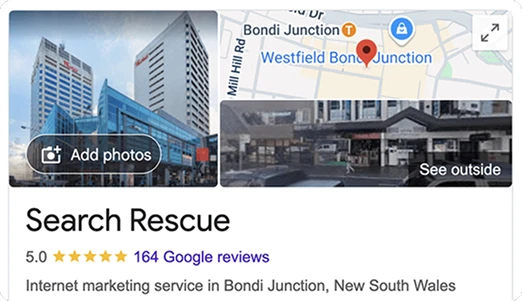
Yes. Search Rescue is based in Bondi Junction, Sydney, and works with online stores across Australia, as well as clients in Singapore. Online stores can target customers anywhere they ship, so your agency’s location doesn’t limit your reach.
Can one agency manage Google, Meta and SEO for my store?
Yes, and it’s usually more effective. One team sees how each channel contributes to sales, avoids double-counting revenue between Google and Meta, and moves budget to where the real return is. Search Rescue manages Google Ads, Meta Ads and SEO for eCommerce stores under one roof.
What is Google Shopping?
Google Shopping ads show your products with an image, title, price and store name at the top of Google search results and in the Shopping tab. They’re driven by a product feed from your website rather than keywords, so they reach people actively searching for products like yours. For most online stores, Shopping is the highest-performing Google campaign type.
What's the difference between Performance Max and Standard Shopping?
Standard Shopping shows your products on Google Search and Shopping, with more control over bids and search terms. Performance Max uses Google’s AI to run your products across Search, Shopping, YouTube, Display, Gmail and Maps from one campaign. Search Rescue chooses the right mix for your products, margins and data. Read the founder’s take on PMax pros and cons.
What is a product feed and Google Merchant Center?
A product feed is a data file listing every product in your store with its title, description, price, images, availability and identifiers. It’s uploaded to Google Merchant Center, which powers your Shopping and Performance Max ads. Feed quality directly affects which searches your products show for, so Search Rescue optimises titles, attributes and categories to improve performance.
Why are my products disapproved in Merchant Center?
Common causes include missing or incorrect prices, shipping or return policy details, missing product identifiers like GTINs, image problems, and restricted products. Mismatches between your website and feed are another frequent issue. Search Rescue reviews Merchant Center diagnostics as part of every eCommerce audit and fixes disapprovals so your full range can show.
What are value-based bid strategies?
They tell Google to optimise for revenue rather than the number of sales. “Maximise conversion value” aims for the most revenue within your budget, and adding a target ROAS tells Google the return you want. These strategies use your sales data to bid more on shoppers likely to spend more, and they work in Shopping, Performance Max and Search campaigns.
Do Search ads still matter for eCommerce?
Yes. Search campaigns capture high-intent searches such as brand terms, product categories and specific models, often with strong ROAS. For stores with large catalogues, AI-driven search formats can write ads and choose landing pages automatically.
How do you stop Google ads wasting money on low-margin products?
Campaigns can be split by margin, price range, best sellers or product category, each with its own ROAS target. Low-margin or low-converting products can get lower targets or be excluded, while high-margin best sellers get more budget. Custom labels in your product feed make this possible.
Is Facebook or Google better for eCommerce?
It depends on your products. Google captures people already searching, so it suits products people actively look for. Meta can significantly outperform Google for products that are interesting, thought-provoking or visually enticing, because it creates demand as people scroll. Most stores do best with both, with budget weighted towards whichever delivers more profit.
What products sell well on Facebook and Instagram?
Products that make people stop scrolling: visually appealing, novel, giftable, lifestyle or impulse items, and products with a clear before-and-after or problem-solving story. Fashion, beauty, homewares, gifts, gadgets and food often perform well. Commodity products that people compare mainly on price usually do better on Google Shopping.
What makes a good eCommerce ad on Meta?
Punchy creative that makes people stop and look. You’re competing with friends, family and every other brand in a busy feed, so the first second matters. Strong product imagery or short video, a clear benefit or offer, and social proof like reviews tend to perform best. Testing several creative variations is essential to find winners.
Which Meta audiences work best for online stores?
Alongside interest targeting, lookalikes and general remarketing, eCommerce works well with specific audiences: cart abandoners, past buyers ready to reorder, loyalty shoppers, upsell and cross-sell audiences, and seasonal shoppers. Search Rescue has 10+ years of experience building these audiences to drive revenue and ROAS.
What are Catalog Ads on Meta?
Catalog Ads, also called Advantage+ catalogue ads, pull products straight from your store’s feed and show them in carousels with titles and prices added automatically. They can show each person the exact products they viewed, which makes them very effective for retargeting. Prices and stock update automatically when you change them on your site.
How do you win back shoppers who abandon their cart?
Retargeting ads on Meta and Google show shoppers the exact products they left behind, often with a reminder of shipping, returns or a time-limited offer. Combined with email or SMS abandoned-cart flows, retargeting is one of the most profitable parts of eCommerce marketing, because these shoppers have already shown strong buying intent.
Do you offer SEO for online stores?
Yes. eCommerce SEO focuses on product and category pages so they rank in Google without paying per click. It includes optimised URLs with product names, detailed titles and descriptions, reviews, schema markup, internal linking, site speed and fixing technical issues like duplicate product URLs. Learn more on the SEO page.
What makes a product page rank well?
A clean URL with the product name, a detailed title including brand, type and size, several images and ideally video, price, specifications, variants, at least 300 words of unique description, customer reviews, product FAQs, shipping details and related products. Read the full guide to SEO for product pages.
Should I use the manufacturer's product descriptions?
It’s better not to. Hundreds of other stores often use the same supplier copy, so Google has little reason to rank your page above theirs. Unique descriptions that answer real buyer questions, mention key specifications and use the words shoppers search for give your products a much better chance of ranking and converting.
Why do category pages matter for eCommerce SEO?
Category and collection pages often target broader, higher-volume searches like “women’s running shoes” or “LED downlights”. Adding helpful introductory content, clear filters, internal links and well-structured product listings helps these pages rank and pass authority to the products within them. For many stores, category pages drive more organic traffic than individual products.
How do I get my products into AI shopping results?
AI tools like ChatGPT, Gemini, Perplexity and Google’s AI Overviews pull from product feeds, structured data and well-written product pages. Accurate Merchant Center feeds, complete product schema, detailed descriptions, genuine reviews and buying guides that answer common questions all improve your chances of being recommended. Search Rescue covers this through its AI optimisation service.
How do you track eCommerce sales accurately?
[confirm: enhanced conversions and Conversions API included]
Why don't Google Ads and Meta revenue figures add up to my store's sales?
Each platform claims credit using its own attribution rules. Meta counts a sale if someone viewed an ad in the last day or clicked in the last 7 days, while Google mostly credits recent clicks. Both can claim the same order. Search Rescue compares platform figures with your store’s real sales to judge each channel’s true contribution.
Should I optimise for revenue or profit?
Profit, wherever possible. Two products with the same revenue can deliver very different profit once product costs, shipping and discounts are counted. Setting ROAS targets based on your margins, splitting campaigns by margin and, where possible, feeding profit data into bidding helps grow the bottom line, not just sales.
How much should I spend on ads for my online store?
It depends on your margins, average order value and growth goals. Start with a budget large enough for Google and Meta to gather sales data, then increase spend while ROAS stays above your break-even point. Search Rescue recommends a starting budget during your free audit.
How do I know when to increase my ad budget?
Increase spend while additional revenue stays profitable. Every account eventually hits diminishing returns, where each extra dollar brings in less. Your net profit margin and repeat order value decide where that point is: if customers reorder often, you can afford a lower first-order ROAS. Founder Ben Guthridge explains this in a video on this page.
Should I follow Google's budget recommendations?
Treat them with caution. Google’s suggestions don’t account for your profit margins, stock levels or customer lifetime value. Scaling should be based on your break-even ROAS and real profit, so Search Rescue reviews each recommendation against your numbers before increasing spend.
How do you prepare for Black Friday and peak sales periods?
Preparation typically starts weeks ahead: refreshing creative, building seasonal and past-buyer audiences, checking feeds and stock, and planning budget increases. During peak periods, budgets and ROAS targets are adjusted daily, and Google’s seasonality adjustments can help bidding respond to short spikes in conversion rates.
What reporting will I receive?
You’ll get weekly and monthly performance reviews with actionable insights, covering revenue, ROAS, orders, average order value, cost per sale and top-performing products. Campaigns are actively managed, tested and refined every week, so reports focus on what changed and what’s next.
What's included in a free eCommerce audit?
Search Rescue reviews your Google Ads, Merchant Center feed, Meta campaigns and tracking setup. You’ll see where budget is being wasted, which products and campaigns could scale profitably, and whether your sales tracking is accurate. It’s honest advice with no sales pitch.
Can you take over my existing ad accounts?
Yes. Search Rescue regularly takes over eCommerce accounts from other agencies or in-house teams. It starts with an audit, then restructures campaigns, feeds and audiences while keeping your historical data, so performance builds on what’s already working.
How do I get started?
Call 1300 107 110 or request a free audit through the contact page. After the audit, the team agrees your revenue and ROAS goals, sets up or checks tracking and feeds, and launches campaigns structured around your product categories and buyer intent.
GET STARTED
Request your free audit
We'll review your SEO or ad account and show you exactly what we'd change before you spend a cent.
- No lock-in contracts
- Response within 1 business day
- You keep full access to your own accounts
Search Rescue | Bondi Junction
F1/9-13 Bronte Rd, Bondi Junction, NSW 2022, Australia.