
Google Shopping Management Sydeny
Google Shopping puts your products in front of customers actively searching to buy, showcasing product images, prices and details to drive more qualified traffic and sales.
Free Google Ads Audit
See what exactly we’d fix. No obligation.
Response within 1 business day.
TRUSTED BY LEADING BRANDS



















last year
for clients
managed
Google reviews
Google Shopping Management
If you sell products online, you need Google Shopping
For most e-commerce businesses Shopping isn’t one channel among many. It’s the channel a grid of images and prices where the buyer often chooses before visiting a website.
That makes it unforgiving. There’s no ad copy to hide behind: your product, price, image and title sit beside every competitor selling the same thing. Across the Performance Max accounts we manage, Shopping delivers the majority of clicks and revenue. Everything else supports it.
The split is consistent: Shopping takes 55% to over 85% of account revenue, and close to 90% of clicks in our most Shopping-dependent accounts. The other surfaces find demand early and re-engage people who didn’t buy but Shopping is the engine. Which means your product data is doing most of the lifting, and that’s where most accounts quietly lose money.




Shopping lives inside Performance Max now
Most advertisers run Shopping inside Performance Max now rather than as a standalone campaign. Your feed goes in, and Google distributes it across Shopping, Search, YouTube, Display, Discover and Gmail.
The split is consistent: Shopping takes 55% to over 85% of account revenue, and close to 90% of clicks in our most Shopping-dependent accounts. The other surfaces find demand early and re-engage people who didn’t buy but Shopping is the engine. Which means your product data is doing most of the lifting, and that’s where most accounts quietly lose money.
What drives performance
1. A competitive offer
Shopping shows your price next to every competitor selling the same product. To win here, you need to be price competitive.
2. Complete product attributes
The biggest lever we pull, and the one most accounts have never had worked on. Google matches searches to products using feed data missing or vague attributes lose the auction before it starts.
Titles do the heavy lifting. A title needs the words both the search engine and the consumer are using rarely what your catalogue calls the product.
What the warehouse calls it:
ExoFit Harness — L/XL
What buyers actually search for:
3M DBI-SALA ExoFit Full Body Safety Harness — Size L/XL — AS/NZS 1891.1 Compliant
Same product, far wider matching. Beyond titles: GTIN, MPN and brand; correct product category and type; clean images with no promotional overlays; price and availability matching the site exactly; descriptions written for matching; and custom labels so margin, seasonality and bestsellers can steer budget.
Titles do the heavy lifting. A title needs the words both the search engine and the consumer are using — rarely what your catalogue calls the product.
3. A clean Merchant Center
Merchant Center sits between your CMS and Google Ads. Products flow from your store into it, and only then become eligible to serve. If it breaks, your ads stop usually quietly.
Feed hygiene is ongoing work, not a setup task. We monitor and act on disapprovals, price mismatches between feed and landing page, out of stock items, and missing attributes that suppress whole product ranges. Some we fix at feed level. Others sit in your website or inventory system we come to you with the specific products and the specific fix, not a screenshot of an error count.
Scaling: finding the inflection point
If a campaign is hitting its ROAS target and impression share is still available, there’s profitable growth going unclaimed.
We’ve taken accounts from $50 a day to peak trading days above $14,000 while holding the target our largest spent $14,743 in a single day at 8.57× return, and $13,876 on Black Friday at 7.51×. That’s not one decision; it’s a sequence of measured increases, each checked against efficiency.
The other half is diminishing returns. Past a point, extra budget buys worse traffic and ROAS slides below commercial sense. That’s the inflection point. The craft is finding the highest budget and highest revenue still on the right side of it.
Profit or revenue? A business chasing market share will accept lower ROAS for more revenue. One optimising margin wants the opposite. Most want both, so it’s a deliberate trade-off. We work it out with you the sweet spot where you’re getting enough sales at enough profitability and we’re specific about what moving the target either way costs or earns.
Tactics that move the needle
Price drops. Drop a price far enough and Google shows it in green with the old price struck through its own signal to shoppers that this is a significant drop, and a real advantage in a grid of competing products. In Australia the discount must be more than 5% and less than 90%, and the base price must have been genuine for 30 days of the preceding 200, so token discounts don’t qualify. Plan periodic, meaningful drops across rotating products, and protect the base prices that make them possible.
Promotions. Merchant promotions put a clickable offer on your listing. With reviews and seller ratings, these decide the click between near-identical products at near-identical prices.
The calendar. Competition and conversion rates spike on known dates, and a feed that isn’t ready misses the window. Black Friday and Cyber Monday are now the biggest trading period of the year for most Australian e-commerce advertisers weeks of preparation, not a budget rise on the day. Then end of financial year, Boxing Day, Mother’s and Father’s Day, Valentine’s Day, end of season clearance and end of month specials.
Summary
Two of the 21 e-commerce accounts have a line graph strong enough for the Google Shopping page: Specialist lighting retailer and Safety equipment retailer. In both, revenue rose about a third while ad spend fell, and Shopping listings drove most of that revenue.
| Account | Ad spend | Revenue | ROAS | Revenue from Shopping listings |
|---|---|---|---|---|
| Specialist lighting retailer | $421K → $295K (−30%) | $1.87M → $2.51M (+34%) | 4.45× → 8.52× | 93% |
| Safety equipment retailer | $806K → $701K (−13%) | $2.69M → $3.53M (+31%) | 3.33× → 5.03× | 80% |
The comparison is Nov 2024–Oct 2025 against Nov 2025–Oct 2026. The Shopping share is for the latest 12 months.
The page copy quotes the lighting retailer as $434,809 → $288,533 spent and 4.44× → 8.31× ROAS. Those figures use a slightly different 12-month window. If this chart goes on the page, update the table to the Nov–Oct figures above so the two match.
The medical device and sleep therapy case in the copy (CPAP Clinic) is not charted. Its monthly ROAS has slipped from about 8× to 4.4× in Oct 2026, so a line graph would undercut the claim. The peak-day figures in the copy can stay.
Results we're getting
Specialist lighting retailer
Shopping drives 87% of clicks and 86% of revenue. The clearest illustration of why more spend isn’t more profit — we cut spend by a third and revenue still grew:
| Previous 12 months | Last 12 months | |
|---|---|---|
| Ad spend | $434,809 | $288,533 (−34%) |
| Revenue | $1.93M | $2.40M (+24%) |
| Return on ad spend | 4.44× | 8.31× |
Specialist Lighting Retailer
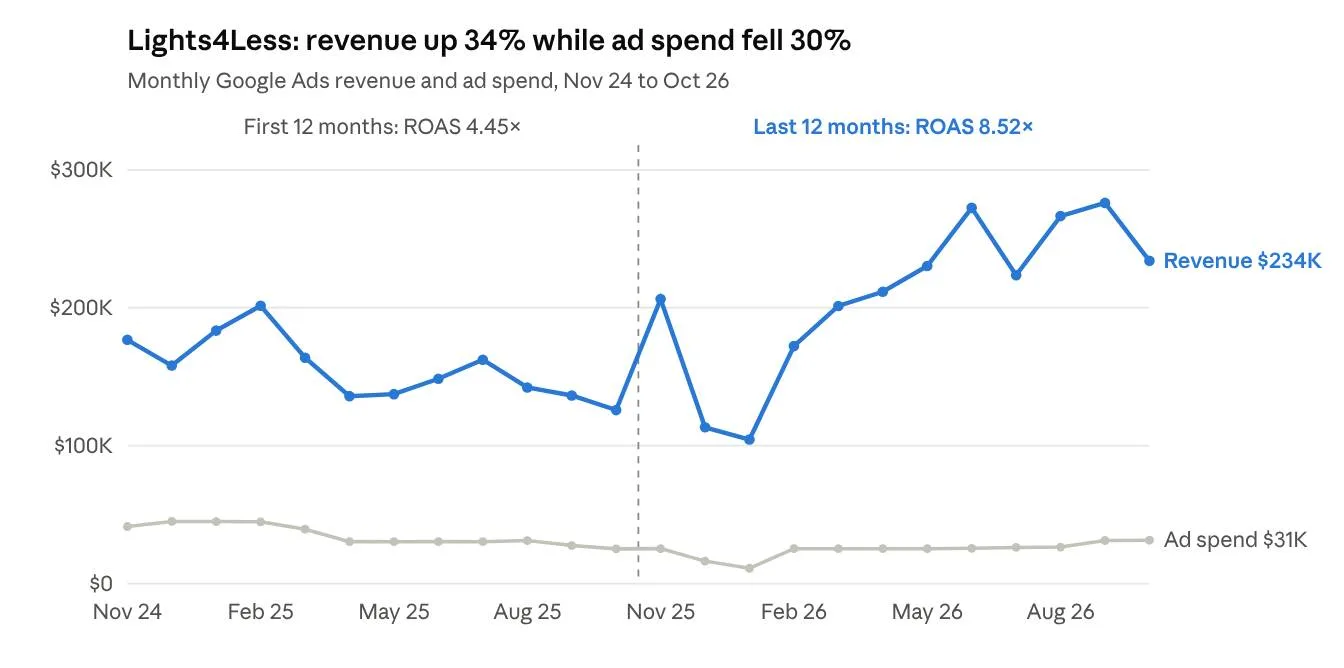
Google Ads, Edyco Group | Lights4Less account · monthly, Nov 2024–Oct 2026 · conversion value = revenue
Monthly spend came down from about $45K to $25K–$31K over 2025. Revenue then climbed past $270K a month by mid-2026. The dip in Dec 2025 and Jan 2026 matches the lower holiday budget.
Safety and Site Equipment
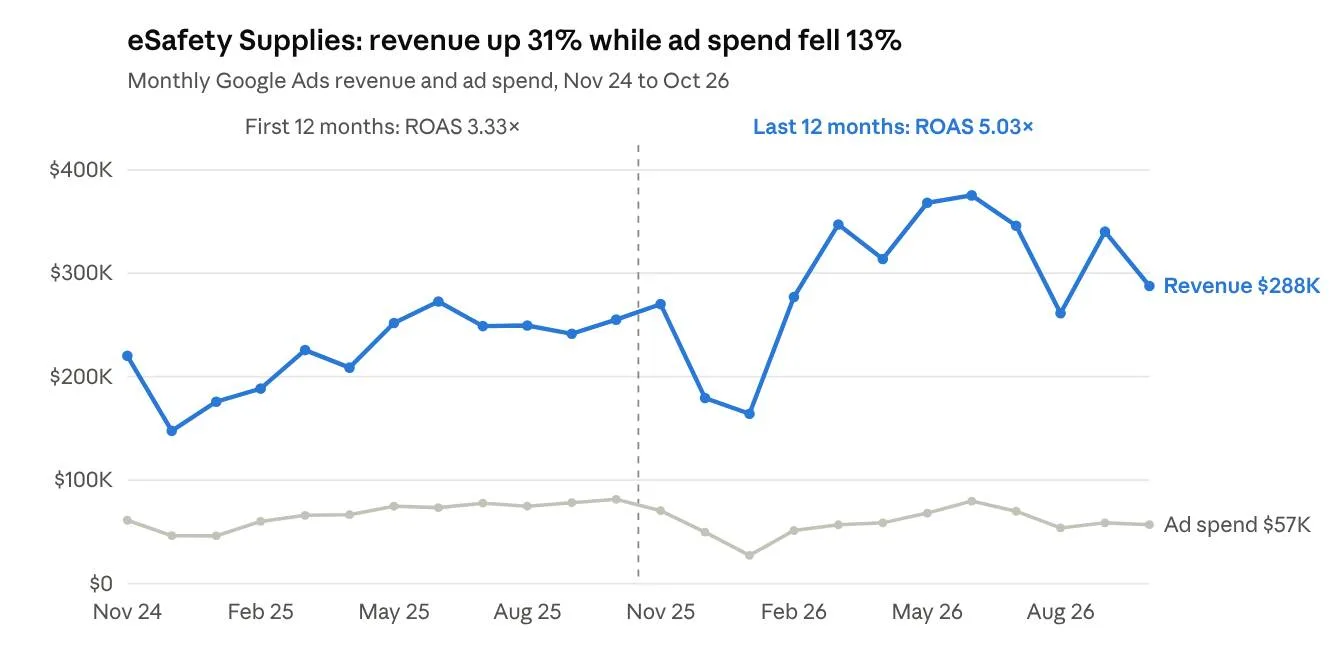
Google Ads, eSafety Supplies account · monthly, Nov 2024–Oct 2026 · conversion value = revenue
Revenue grew from about $150K–$225K a month in early 2025 to $310K–$375K a month from Mar to Jul 2026. Monthly spend stayed in a similar range ($57K–$80K). The Jan 2026 low matches the lower holiday budget.
SERP Results
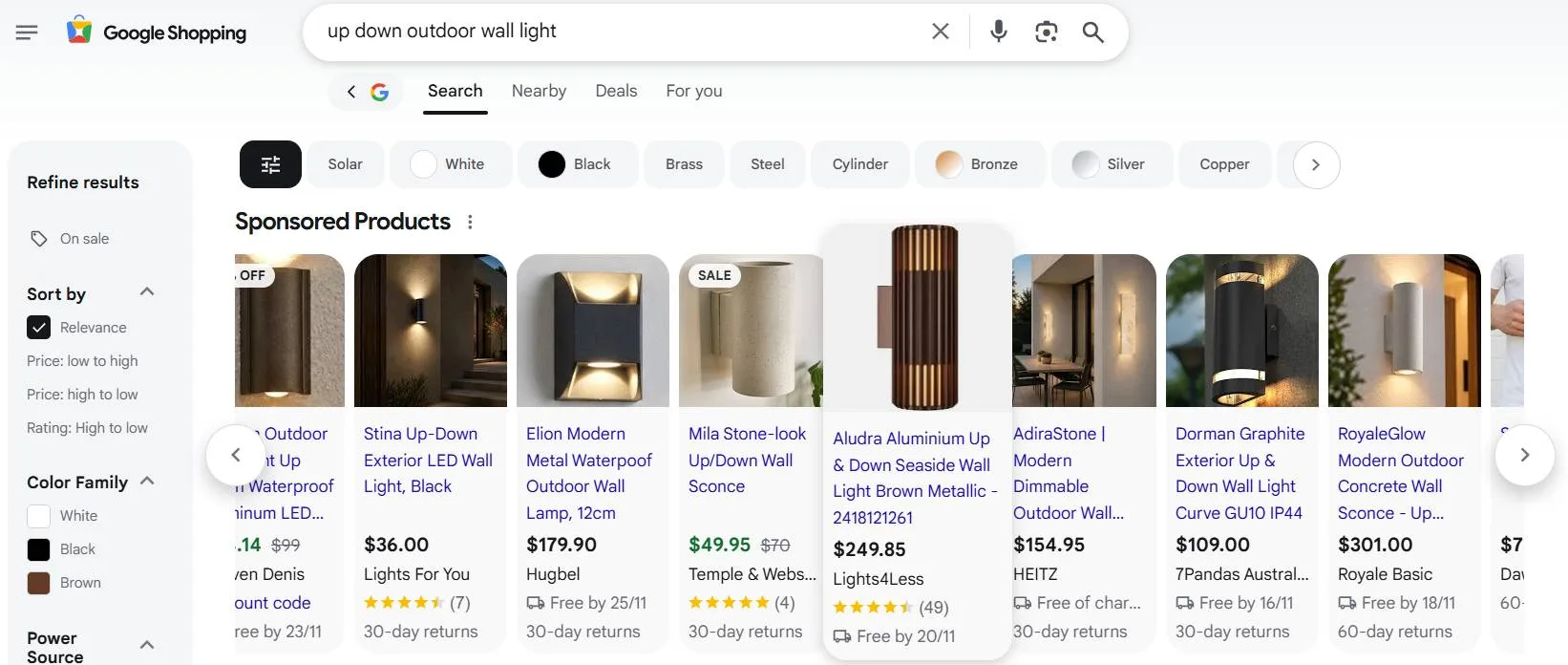
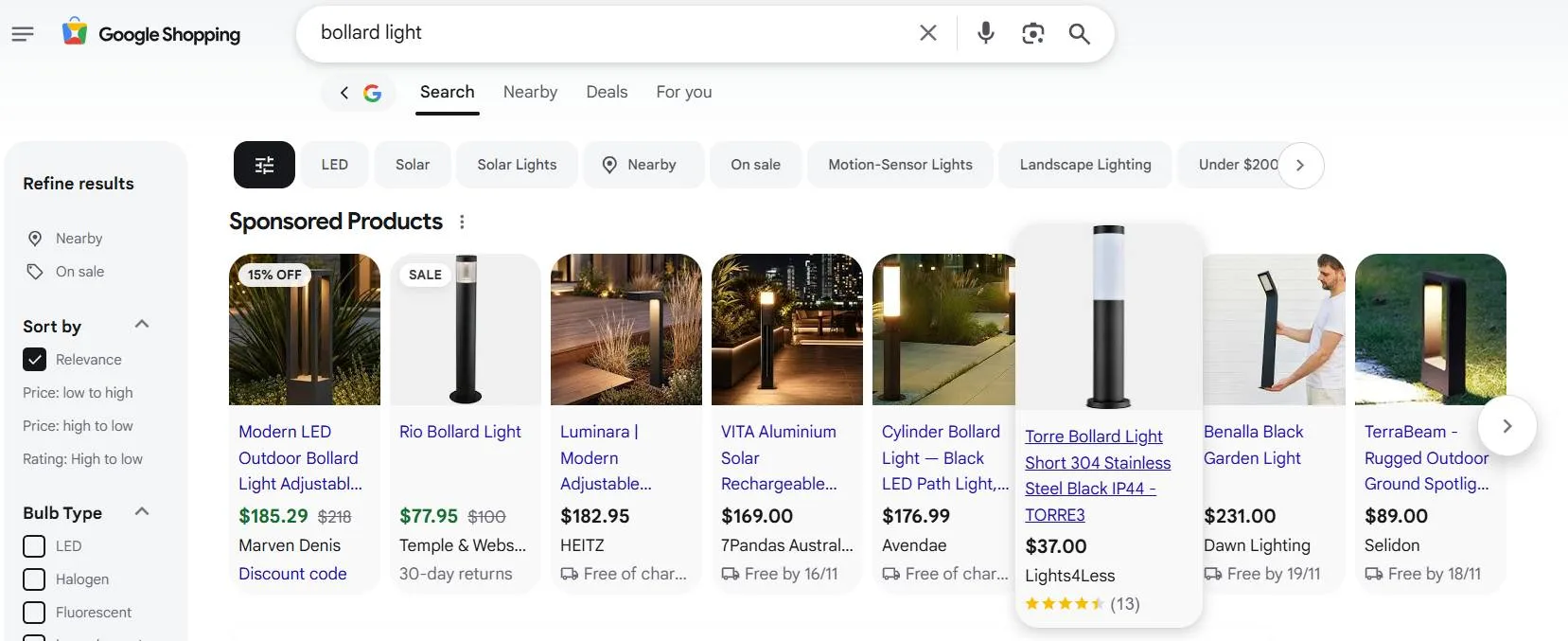
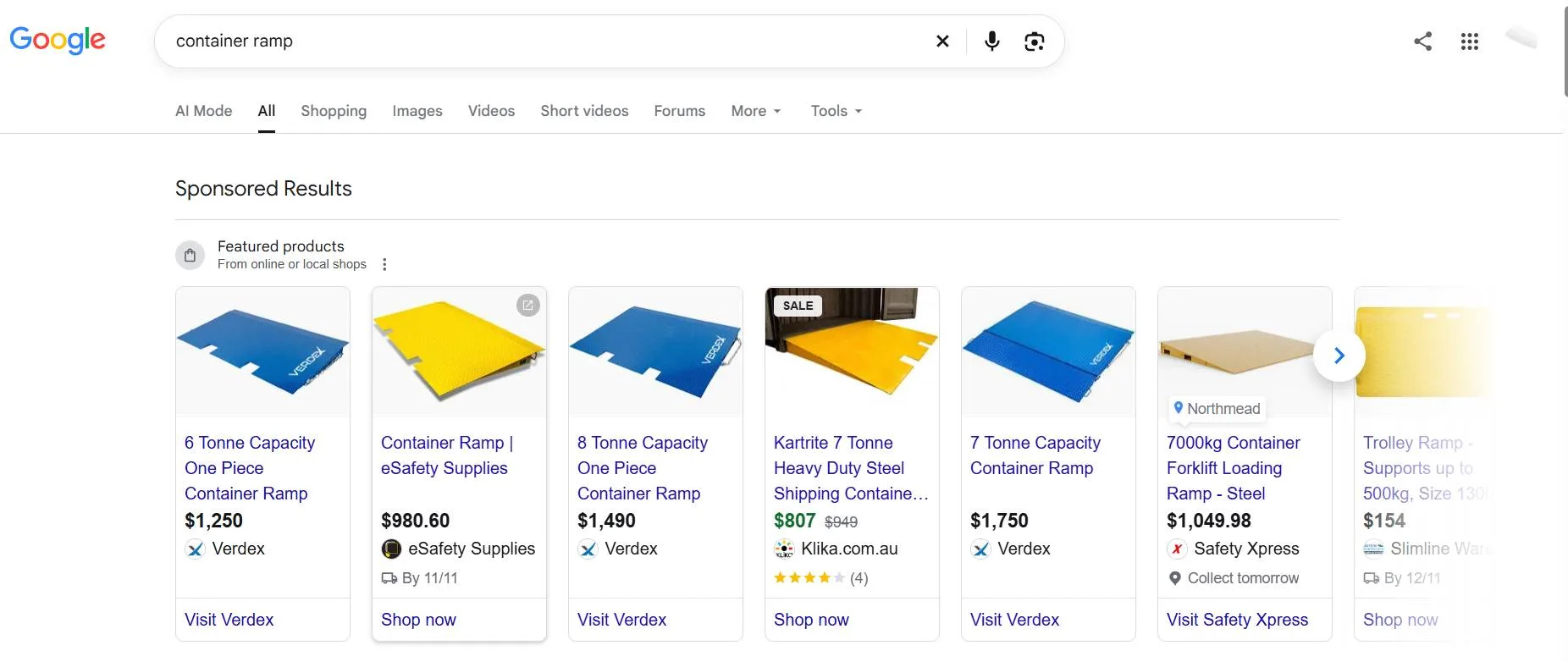
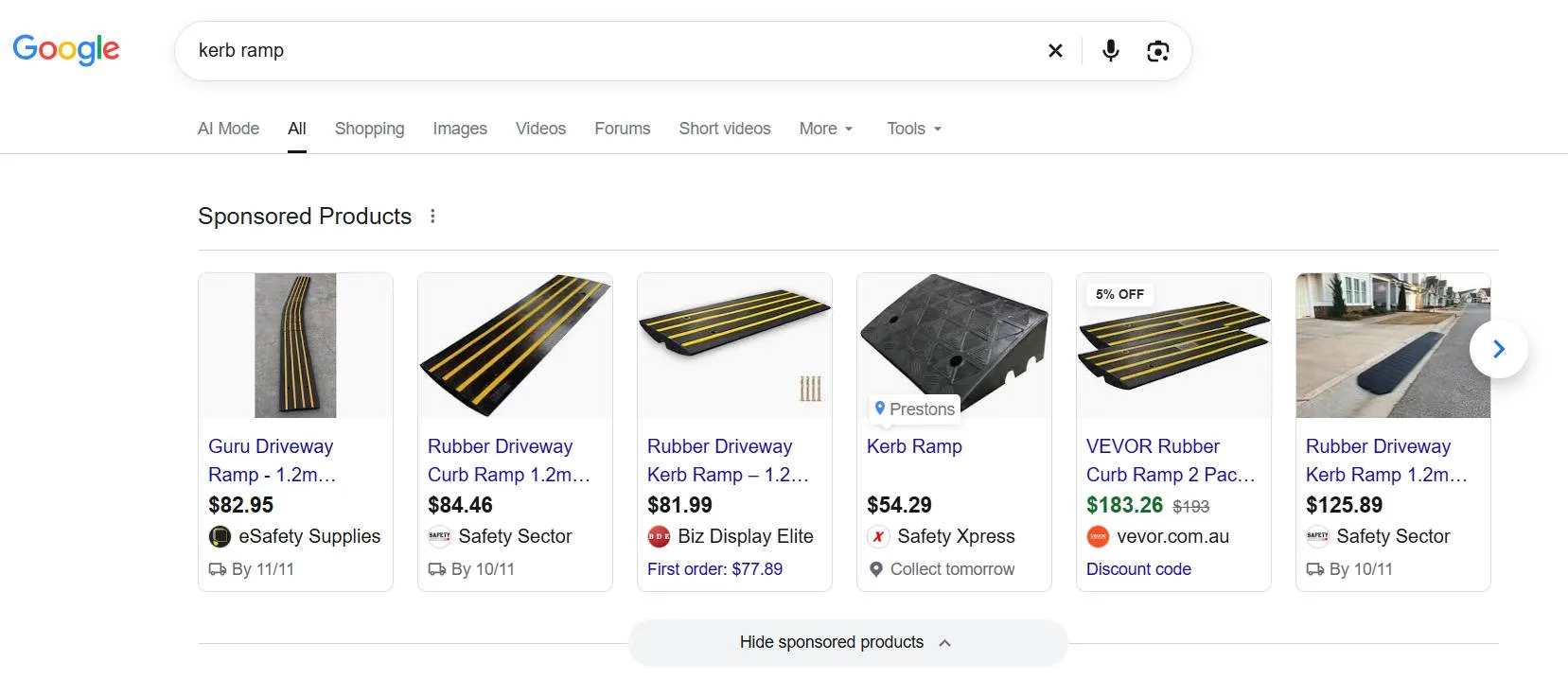
Shopify Results
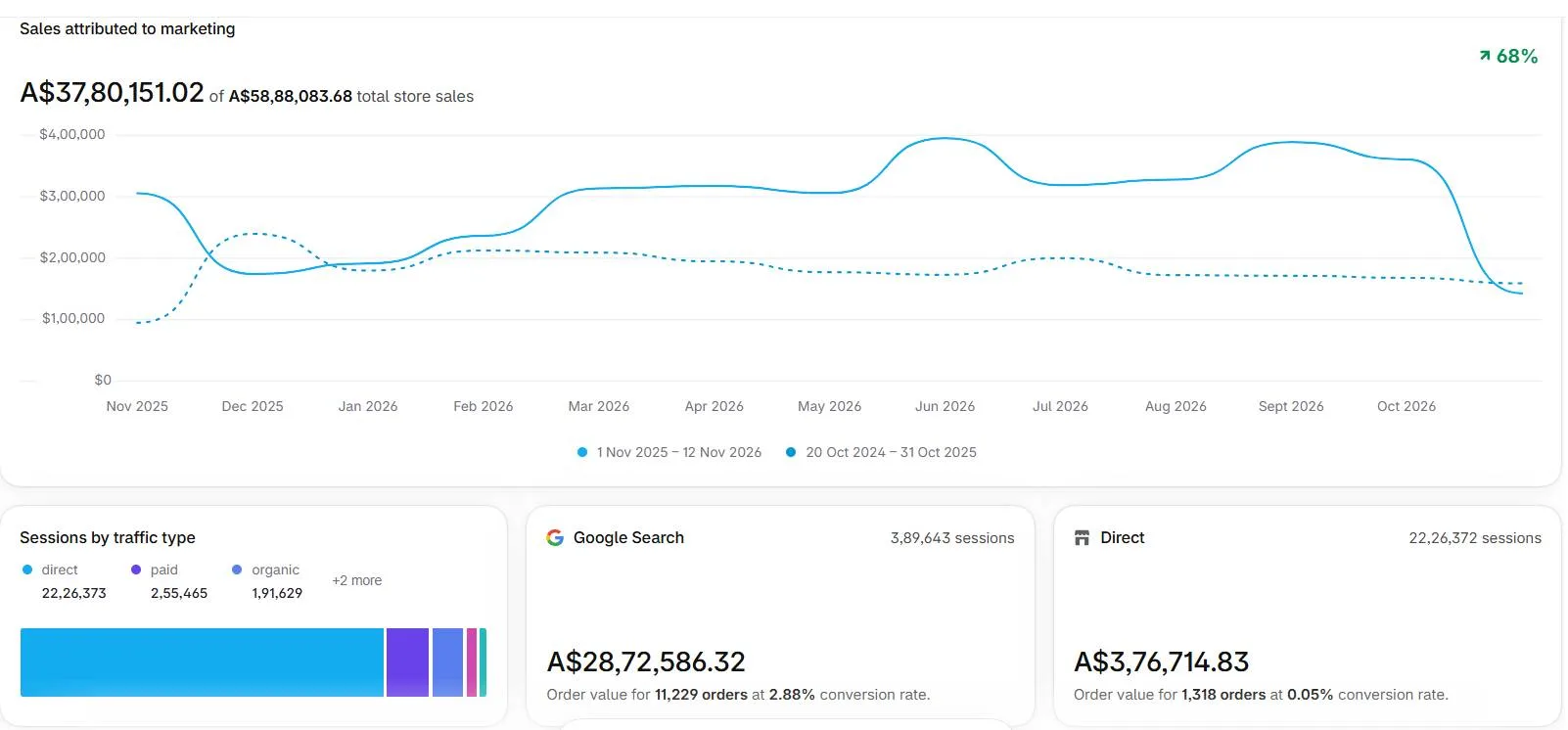
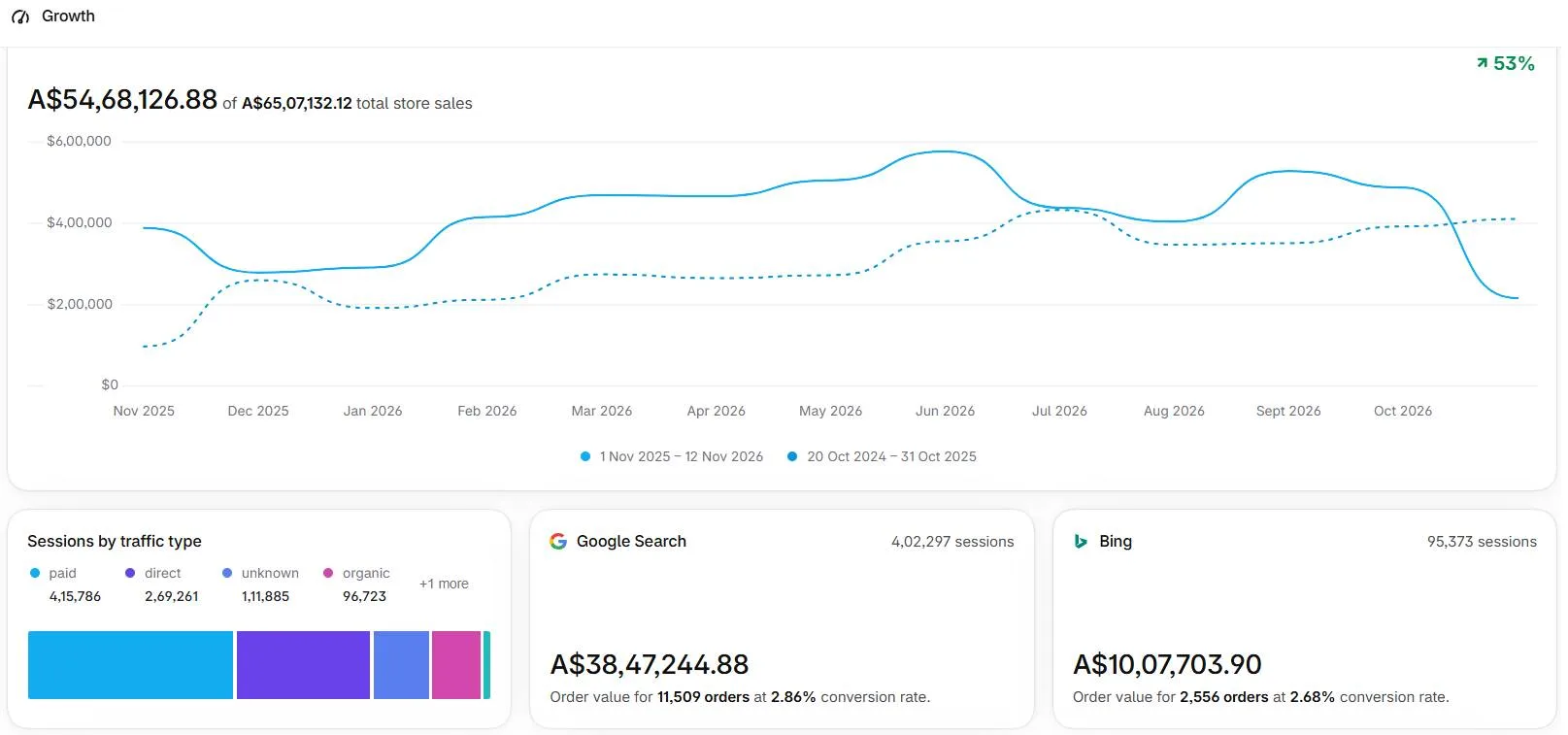
Medical device and sleep therapy retailer
Shopping at scale: $4.05M in ad spend returning $28.2M at 6.96× over 24 months, with the Shopping surface alone at 7.35× and 57% of account revenue.
It’s the account behind the peak days above — $14,743 at 8.57× on 30 June, $13,876 on Black Friday at 7.51×. A prepared account absorbs three times its normal budget without losing efficiency.
Our Google Shopping Ads strategy improves your product visibility and reaches high-intent shoppers. By tightening your product feed and targeting campaigns by margin, we drive more qualified traffic and more sales. Browse our Google Ads case studies to see how it works in practice.
What we do
Merchant Center setup, auditing and ongoing hygiene
Feed optimisation — titles, attributes, categorisation, images, custom labels
Performance Max and Shopping structure built around your margin
Bid strategy and ROAS target management
Staged scaling toward your inflection point
Disapproval and policy resolution
Seasonal and promotional planning
Reporting on revenue and return, not impressions
Testimonials
faq'S
Frequently Asked Questions
Is Google Shopping the same as Performance Max?
No. Performance Max is a campaign type; Shopping is one surface it serves on — and for most e-commerce advertisers, where the majority of its revenue comes from.
Do I need a Merchant Center account?
Yes. Products flow through it before they can appear in Shopping. We can set one up or clean up an existing one.
Why have my products been disapproved?
Usually a price mismatch with the landing page, missing GTINs, promotional overlays on images, availability out of sync with stock, or a category restriction.
How much should I spend?
Whatever the account can absorb while still hitting your ROAS target — usually more than owners expect.
Can you work with my platform?
Shopify, WooCommerce, BigCommerce, Magento and custom builds. The feed path differs; the principles don’t.
GET STARTED
Request your free audit
We'll review your SEO or ad account and show you exactly what we'd change before you spend a cent.
- No lock-in contracts
- Response within 1 business day
- You keep full access to your own accounts
Search Rescue | Bondi Junction
F1/9-13 Bronte Rd, Bondi Junction, NSW 2022, Australia.